



Introduction
As global financial systems become increasingly interconnected, cross-border payments play an essential role in shaping digital economies. For millions of Indians and Filipinos working abroad, sending money between India and the Philippines has become commonplace—fueling the need for clear, reliable, and fast currency conversion processes. Understanding how indian currency interacts with today’s leading 菲律宾支付 channels helps users and businesses optimize costs, reduce delays, and ensure smooth financial transactions.
Whether it’s sending money from India to the Philippines, receiving payments in pesos, converting rupees for commerce, or transferring funds between digital wallets, the fundamentals of conversion matter. This guide breaks down how Indian currency conversion works, how exchange rates are applied, how top Philippines payment tools handle these transfers, and what users should expect as financial technology evolves.
Understanding Indian Currency and Its Role in Cross-Border Payments
To grasp how conversions work, we must first understand the characteristics of indian currency, how it is circulated, and how it interacts with foreign markets like the Philippines.
What Is Indian Currency?
Indian currency, the Indian Rupee (INR), is:
- issued by the Reserve Bank of India
- widely used across South Asia
- available in multiple denominations
- influenced by domestic fiscal policy and global markets
Rupee Behavior in International Exchange
Unlike fully internationalized currencies (USD, EUR), the rupee:
- is partially regulated
- may not be accepted directly in some regions
- requires conversion when dealing with Philippine Peso (PHP)
However, international remittance channels and fintech platforms now make INR-PHP conversion easier than ever.
Why Indian Currency Flows Matter to the Philippines
Several factors influence this relationship:
- growing Indian workforce in the Philippines
- Indian expats sending funds to Filipino partners or businesses
- Indian-owned companies operating in Manila, Cebu, and Davao
- tourism between both countries
- international education and outsourcing industries
Thus, conversion between indian currency and PHP is becoming increasingly important for both personal and business needs.
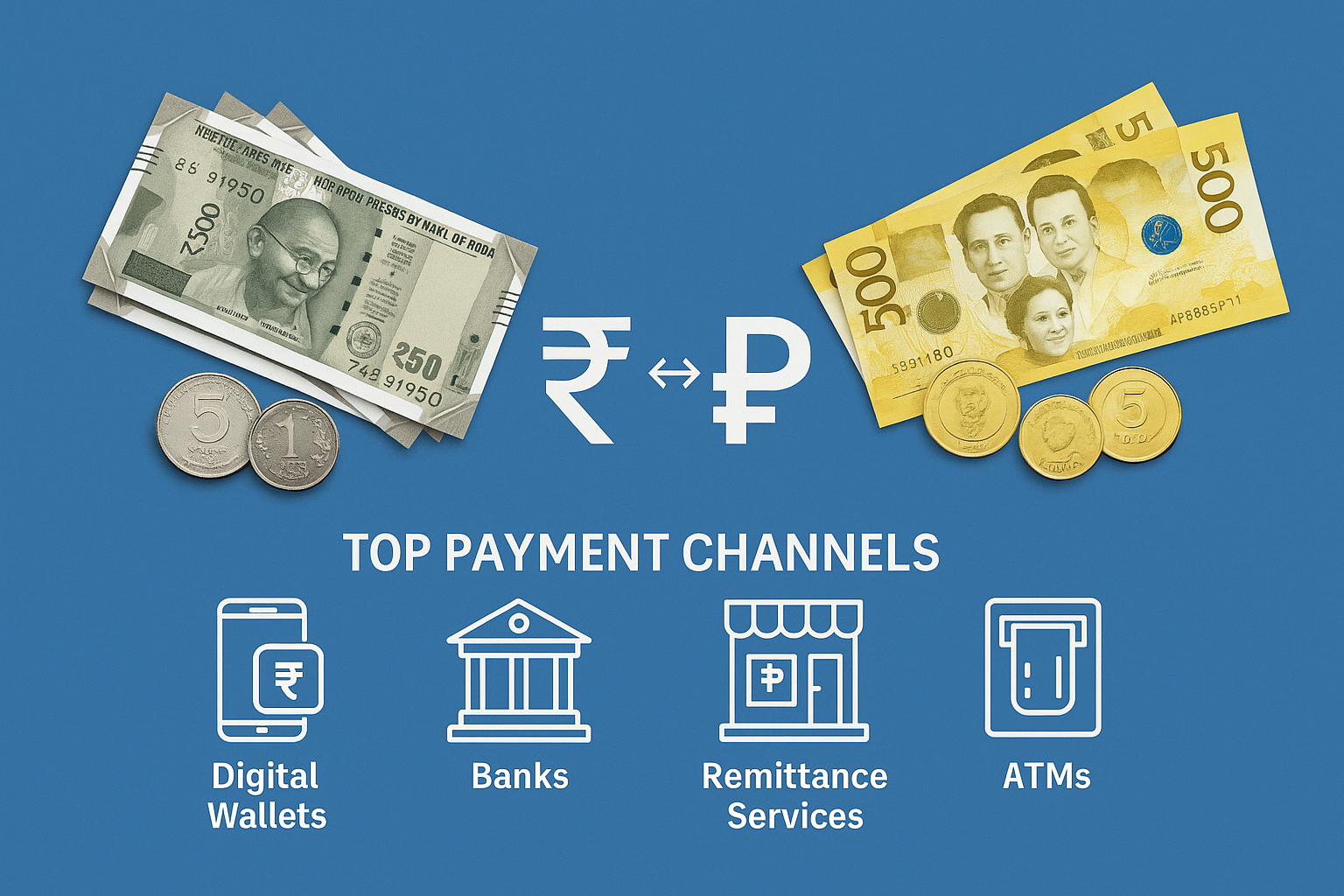
Overview of the Philippines Payment Infrastructure
To understand how conversion works, we must explore modern philippines payment channels.
Digital Wallets
- GCash
- Maya
- Coins.ph
- GrabPay
These wallets allow:
- domestic transfers
- remittance claiming
- QR payments
- bill payments
- fund withdrawals
Bank Networks
Philippine banks use two primary rails:
- InstaPay – instant retail transfers
- PESONet – batch transfers for larger amounts
Remittance Partners
International platforms connect Indian senders to Philippine receivers through:
- Western Union
- Remitly
- Wise
- Xoom
- PayPal
- bank-to-bank cross-border systems
QR and Cash-Out Infrastructure
Once money arrives in PHP:
- users can scan QR Ph
- withdraw through ATMs
- cash-out via partner stores
- pay merchants online and offline
The strength of the philippines payment ecosystem allows incoming funds from India to circulate efficiently.
How Indian Currency Conversion Works When Sending Money to the Philippines
Let’s break down the full process from INR initiation to PHP receipt.
Step 1: Selecting a Cross-Border Payment Channel
Senders choose from:
- digital wallet remittance apps
- bank wire transfers
- cash pickup services
- fintech platforms
Each option applies different exchange rates, processing fees, and speeds.
Step 2: Indian Currency Exchange Rate Calculation
Two major rate models exist:
- Real-Time Market Rate
This follows:
- global forex demand
- economic performance
- geopolitical factors
- Provider-Adjusted Rate
Payment platforms often add a margin, resulting in:
- slightly lower PHP value
- additional conversion fees
Consumers must compare these rates before sending money.
Step 3: Conversion of Indian Currency (INR) into PHP
Once the rate is determined:
- INR amount is deducted from the sender.
- The payment platform converts the amount.
- PHP balance is transferred to the chosen philippines payment channel.
For example:
- ₹10,000 INR → PHP 6,700 (approx., depending on rate)
Step 4: Transfer to Philippine Wallet or Bank
After conversion:
- money is deposited into GCash, Maya, or a bank
- some providers send funds instantly
- others take 24–48 hours
Processing time varies depending on:
- compliance checks
- verification requirements
- transfer network capacity
Step 5: Final Withdrawal or Spending in the Philippines
Once received, PHP funds may be:
- withdrawn at ATMs
- spent digitally via QR Ph
- transferred to other wallets
- cashed-out at partner stores
Thus, philippines payment platforms complete the final stage of remittance distribution.
Currency Conversion Mechanics: INR → PHP
Understanding how conversion works helps users make smarter financial decisions.
Factors That Influence Indian Currency Conversion
- Global Forex Market
When global USD value rises, INR may weaken, affecting PHP exchange rates.
- Monetary Policy
India’s central bank decisions affect rupee stability.
- Remittance Volume
High demand for transfers can cause providers to adjust their margins.
- Provider Fees
Platforms use:
- service fees
- conversion margins
- delivery fees
- Local Regulations
Both India and the Philippines impose compliance checks that may affect processing times.
Mid-Market Rate vs. Provider Rate
Mid-Market
- most accurate
- used for forex trading
- rarely offered directly to consumers
Provider Rate
- mid-market ± platform margin
- affects final PHP amount
Understanding this distinction helps users maximize conversion value when transferring indian currency.
Hidden Fees to Watch Out For
Some platforms charge:
- “convenience fees”
- extra service charges
- per-transaction deductions
These can significantly reduce the PHP amount received.
How Top Philippines Payment Channels Handle Indian Currency Conversion
Now, let’s explore how each major philippines payment tool interacts with remittances originating from Indian currency.
GCash
GCash is currently the most popular digital wallet in the Philippines.
How It Works With Indian Currency
- Indian senders use remittance apps connected to GCash
- INR is converted before being pushed to PHP
- Recipient gets PHP instantly
Pros
- instant claiming
- low cost for local spending
- excellent merchant acceptance
Cons
- not all Indian banks connect directly
- rate margins vary depending on provider
Maya
Capabilities
- wallet-to-wallet transfers
- bank transfers
- QR Ph payments
Indian Currency Compatibility
Maya receives PHP from remittance partners after indian currency conversion. The conversion does not occur inside Maya itself but through the sender’s chosen platform.
Coins.ph
Coins.ph specializes in:
- crypto-based transfers
- remittance acceptance
- wallet-based cash-out
Indian Currency Flow
- INR → platform conversion → PHP → Coins.ph wallet
This platform is useful for users who prefer blockchain-supported transfers.
Banks: BDO, BPI, Metrobank, Landbank
Bank-to-Bank Transfers
Indian banks do not directly connect to Philippine banks, so intermediaries handle conversion.
Flow:
INR ⇒ remittance provider ⇒ PH bank in PHP
Advantages
- secure
- large transfers possible
- predictable processing
Remittance Centers and Cash-Out Partners
Companies like Western Union provide:
- both online and cash pickups
- competitive INR → PHP conversion
These are essential for recipients in remote areas with limited wallet access.
Comparing Conversion Methods for Indian Currency to the Philippines
Let’s examine which method provides the best value depending on user priorities.
Fastest Method
- Dedicated fintech remittance platforms
- Real-time wallet transfers
Lowest Cost Method
- mid-market rate-based platforms
- Wise (depending on country availability)
Best for Rural Recipients
- Western Union
- Remit centers
- Banks with physical branches
Best for Digital-First Users
- GCash
- Maya
- Coins.ph
Challenges in Indian Currency Conversion Through Philippines Payment Channels
Understanding friction points helps in improving user experience.
Regulatory Barriers
- anti-money laundering checks
- identity verification delays
Exchange Rate Fluctuation
Rates change hourly:
- affecting transfer timing
- influencing total PHP received
Provider Limitations
Not all providers support direct INR transfers. Some require:
- conversion into USD first
- longer processing times
Seamless Integration Issues
Digital wallet compatibility across borders is still evolving.
Future Trends in INR-PHP Conversion and Philippines Payment Tools
Based on global financial developments, several trends are emerging.
More Direct India-to-Philippines Payment Corridors
Fintech partnerships are increasing. Soon, more platforms will:
- support INR directly
- enable instant INR → PHP transfers
- reduce reliance on third-party intermediaries
Lower Fees Through Competition
As more companies enter the market:
- margins will shrink
- transaction costs will drop
- users will receive higher PHP amounts
Real-Time Settlement for Cross-Border Payments
The Philippines may adopt models inspired by India’s UPI system:
- unified digital transfer rails
- instant cross-border capabilities
Integration of Digital Currency
If India launches a digital rupee and the Philippines develops a digital peso, transfers could become:
- nearly instant
- fee-reduced
- highly transparent
Strengthened Digital Wallet Features
Philippine wallets may incorporate:
- automatic conversion tools
- instant rate comparison
- real-time remittance dashboards
Conclusion
The world of cross-border payments is moving quickly, and understanding how 印度货币interacts with the expanding philippines payment ecosystem is essential for users and businesses alike. As conversion tools improve, as new fintech partnerships emerge, and as both countries strengthen their digital infrastructures, the future of INR → PHP payments will become faster, cheaper, and more seamless.
By learning how conversion works—rates, fees, channels, and tools—users gain control over their financial decisions. As innovation continues, both India and the Philippines stand to benefit from a stronger, more connected digital economy.
